My Favorite Spring Hikes on Etna: Trails & Blooms
A volcanological guide's personal take on hiking Europe's most spectacular active volcano when it comes alive in spring
Why I always tell people: come in spring
People ask me this all the time — "Vincenzo, when's the best time to visit Etna?" And my answer is always the same: April through June, no question. I've walked this mountain in every season. Summer brings the crowds and the heat. Autumn has its charm. Winter, well, that's a different beast entirely. But spring? Spring is when Etna reveals itself.
At mid-altitude, temperatures hover between 10 and 20 degrees Celsius — perfect hiking weather. You're not sweating through your shirt or fighting off sunstroke. And the mountain is quiet. The tour buses haven't shown up yet, which means you can stand on the rim of the Valle del Bove and hear absolutely nothing but the wind.
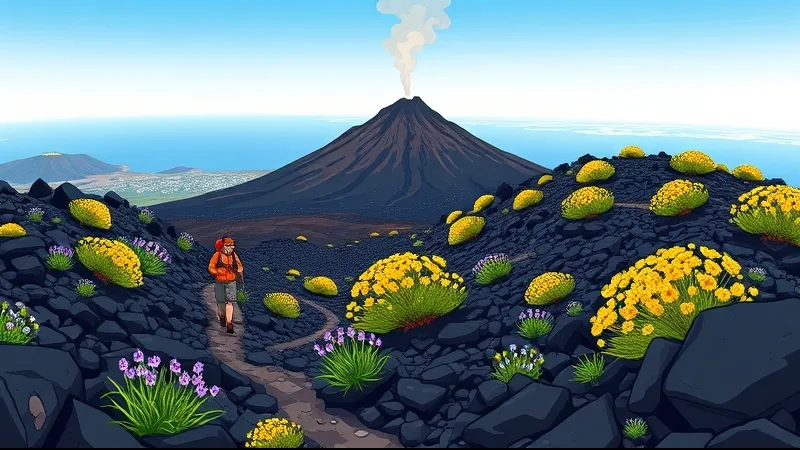
What really gets me, though, is the flowers. I'm a volcanologist at heart, obsessed with lava flows and eruptive cycles — but even I stop and crouch down to photograph a violet pushing through a crack in centuries-old basalt. That contrast between the raw black rock and the delicate petals never gets old.
By mid-April, the north side at Piano Provenzana reopens after winter, so the full trail network across Parco dell'Etna is accessible again. From Rifugio Sapienza you can reach around 2,900 m using the cable car and the authorized 4×4 service. Lower paths up to about 2,000 m are free to walk on your own. Remember that Etna has been a UNESCO World Heritage Site since 2013 — and when you walk these slopes in spring, you understand immediately why.
The trails I recommend to my guests
Over the years I've walked every path on this mountain. Some I love for the views, some for the geology, some because they're perfect for a first-timer. Here are the ones I keep coming back to in spring.
Schiena dell'Asino — my personal favourite
Starting altitude: 1,900 m · Difficulty: moderate
If I could only take someone on one trail, this would be it. The name means "Donkey's Back" — a ridge that climbs to around 2,000 m on the eastern flank, right above the Valle del Bove. The first time I brought a guest up there and watched her jaw drop at that enormous horseshoe depression, I understood why I became a guide.
In spring, the ridgeline is cushioned with Astragalus siculus — these spiny, compact plants that look like they're clinging on for dear life against the volcanic wind — and dotted with early Viola aetnensis. The footing is mixed: compacted volcanic soil with some loose scoria, so I always tell people to wear proper boots, not trainers. The trailhead is just east of Rifugio Sapienza. Allow two to three hours and don't rush it — the panorama deserves your full attention.
Monti Sartorius — where I take families
Starting altitude: 1,670 m · Difficulty: easy
This is the trail I recommend when someone says "I'm not really a hiker, but I want to feel like I am." It's an interpretive nature loop on the north-east flank, winding through a forest of Betula aetnensis — the Etna birch. You won't find this tree anywhere else on Earth. In spring, when those birches are leafing out and the forest floor is covered in wildflowers, it feels almost magical for a volcanic landscape.
The path circles a chain of small craters from the 1865 eruption. I love pointing those out to kids — watching them connect a shape in the ground to an actual historical eruption. You access this trail from the SP Mareneve road above Linguaglossa. It's suitable for everyone, including young children.
The Altomontana — for the long-haul wanderers
Altitude range: 1,400–1,800 m · Difficulty: moderate
This long-distance trail crosses Etna's western and northern flanks through ancient forests of black pine and beech. I don't often walk the whole thing in a single day — nobody should, really — but individual sections are superb for spring day hikes. The altitude stays below the snowline, the trees keep you sheltered, and around every bend the vegetation changes.
My favourite stretch is between Rifugio Galvarina and Rifugio Timparossa. In May, the forest understorey is extraordinary — layers of endemic plants flowering at different heights. I slow down considerably on this section and my guests always thank me for it.
Piano Provenzana to the Observatory — for the adventurous
Starting altitude: 1,800 m · Difficulty: moderate to challenging
This route on the north side climbs through the 2002 lava flow — a stark, moonlike landscape — toward the old volcanological observatory at around 2,800 m. In spring, especially April and early May, there are still snow patches higher up. Some guests find this intimidating. I find it thrilling.
What I love most about this route is showing people the 2002 flow up close. It's still largely barren — barely any plants have colonised it yet. Then I point to an older flow ten metres away, covered in pioneer lichens and scrub. That's ecological succession happening in front of your eyes, and it's something textbooks can't really convey.
Grotta del Gelo — Europe's southernmost glacier
Starting altitude: 2,030 m · Difficulty: moderate
Not many people know about this one, which is part of why I like it. On Etna's north-west flank there's a lava cave permanently filled with ice — Europe's southernmost glacier. The hike to get there crosses lava flows of wildly different ages, and I use each one as a chapter in a story: bare rock, then the first lichen, then Genista aetnensis scrub, then denser vegetation. By the time we reach the cave, guests understand how life slowly reclaims volcanic ground.
The terrain is rough aa lava — the jagged, chunky kind — so ankle support is non-negotiable. I've seen people attempt this in sandals. Please don't.
Crateri Silvestri — the quick introduction
Starting altitude: 1,900 m · Difficulty: easy
When someone has only an hour and wants a taste of Etna, I send them here. The loop around these two craters near Rifugio Sapienza is flat, well-marked, and genuinely impressive. In late spring, Genista aetnensis starts flowering along the crater rims — that bright yellow against the black rock is a photographer's dream.
The wildflowers that stop me in my tracks every spring
I often joke with colleagues that I became a volcanologist but secretly I'm also a botanist. Etna does that to you. The altitude range here — from sea level up past 3,300 m — compressed into such a small area creates an extraordinary variety of habitats. Many of these plants exist nowhere else on Earth.
Lower slopes (500–1,500 m): the Mediterranean garden
- Wild orchids — I still get excited every time I find an Ophrys in a woodland clearing. March through May, you'll come across several species if you look carefully
- Cistus (rock rose) — the white and pink flowers blanketing the lower slopes in April are one of the first signs of spring on the mountain
- Euphorbia — those vivid green spurge bushes colonising disturbed lava terrain are impossible to miss
- Rosemary, heather, and broom fill the air with a scent I associate permanently with this mountain
Mid-altitude (1,500–2,500 m): the endemics
- Astragalus siculus — I always kneel down and show guests how these cushion plants anchor themselves directly onto bare lava. They're like little fortresses. Flowers May–June.
- Genista aetnensis (Etna broom) — this grows here and in Sardinia, nowhere else. It can reach five metres and in June turns entire hillsides gold. I've photographed it hundreds of times and it never looks the same twice.
- Berberis aetnensis — modest yellow flowers in spring, vivid red berries by autumn. I use it as a reference point when I'm explaining seasonal changes to guests.
- Betula aetnensis — not a flower, but the fresh green of the Etna birch coming back to life in April is one of the most beautiful things on this mountain
High altitude (above 2,500 m): the pioneers
- Viola aetnensis — this is the one. This small endemic violet grows directly on bare lava and volcanic sand above 2,500 m. Every time I find it in bloom, I stop the group and make everyone look closely. A purple-and-white flower on black rock at 2,700 m. It shouldn't be possible, and yet here it is.
- Senecio aetnensis — small yellow daisy-like flowers on the upper slopes, another species found only here
- Rumex aetnensis — an endemic dock that keeps the Viola aetnensis company at the highest elevations
My advice: aim for May through mid-June. That's when the mid-altitude endemics overlap with the high-altitude pioneers and you get the widest possible show. By July the lower slopes are baked dry and the spectacle moves upward.
How hard is it, really?
I'm honest with my guests about this. Etna is harder per kilometre than most mountain trails at the same altitude. The surface — loose scoria, sharp aa lava, uneven pahoehoe — demands more from your legs and ankles than a gravel path in the Alps.
- Easy (Monti Sartorius, Crateri Silvestri): I bring guests of all ages and fitness levels here. No experience needed, just sensible footwear.
- Moderate (Schiena dell'Asino, Grotta del Gelo, Altomontana sections): 200–500 m of elevation gain, rough ground. You need proper hiking boots and a reasonable base level of fitness. If you walk regularly, you'll be fine.
- Challenging (Piano Provenzana to the Observatory, summit area): 800–1,200 m gain, steep scoria slopes, possible snow and ice above 2,500 m in April and early May. This is genuine mountain terrain and should be treated as such.
One rule I cannot stress enough: above approximately 2,920 m you must be with an authorized volcanological guide. This is Parco dell'Etna regulation, not a suggestion. The summit is an active volcanic environment and conditions can change within minutes. I've seen calm days turn dangerous very quickly up there.
For anyone who wants the high-altitude experience without the physical challenge, the cable car and 4×4 service from Rifugio Sapienza gets you to around 2,900 m with minimal effort. From there, we do a guided walk of the upper craters.
What I always pack — and what I tell guests to pack
Etna's weather is one of the things that surprises guests most. At the base it can be a beautiful spring day; at 2,900 m it can be zero degrees and windy. I've seen guests arrive at Rifugio Sapienza in shorts and flip-flops for a summit excursion. My job partly involves managing that situation diplomatically.
- Layered clothing — a moisture-wicking base layer, a fleece or down jacket, and a windproof outer shell. No cotton — it holds moisture and chills you fast on the mountain
- A proper waterproof jacket — spring showers can arrive in fifteen minutes with no warning. I carry mine every single time, even on clear days.
- Ankle-high hiking boots with good grip — I say this at every briefing and I'll say it here: trainers and sneakers are not suitable for volcanic terrain. The lava will destroy them and your ankles will suffer.
- Gaiters — essential above 2,500 m in early spring for snow and mud, and useful year-round for keeping volcanic grit out of your boots
- Sun protection — UV at altitude is intense. I use SPF 50 on my face, glacier glasses, and a hat. Every day.
- At least 1.5 litres of water per person — there are no natural water sources above about 1,500 m. I've refilled a guest's bottle from my own more times than I can count.
- Food — energy bars, nuts, dried fruit. Once you're on the trail, there are no shops.
- A camera or decent phone — wildflowers against black lava is one of the most striking images you'll find anywhere in Europe. Use the macro mode for flowers; you'll thank me later.
- Trekking poles — I use them on every descent on loose scoria. They save your knees.
Getting here: the routes I use
Etna is accessible from three main sides. Each has a completely different character.
South side — Rifugio Sapienza (1,923 m)
This is where I work most often. From Catania, you drive south on the SP92 through Nicolosi — the road is well-signed. There's a large car park (around €3–5 per day). The cable car station, a few restaurants, and equipment rental are all here. AST buses run a daily service from Catania during hiking season, which is handy if you're arriving without a car. GPS: 37.7000° N, 14.9994° E.
North side — Piano Provenzana (1,800 m)
Quieter, wilder, and my personal favourite side of the mountain in terms of landscape. From Linguaglossa, follow the SP Mareneve road uphill. Free parking. This is where you access the birch forests, Monti Sartorius, and the north-face routes. GPS: 37.7933° N, 15.0544° E.
East side — Valle del Bove access
Several trailheads on the eastern flank lead to the Valle del Bove rim and the Schiena dell'Asino trail. You reach them from Zafferana Etnea via local roads. GPS for the Schiena dell'Asino trailhead: approximately 37.7050° N, 15.0200° E.
Getting here without a car
From Taormina, several operators run daily shuttles to Rifugio Sapienza — worth checking if you're staying on the coast. The Ferrovia Circumetnea, the old narrow-gauge railway that circles the base of the volcano, won't get you to the trailheads, but it's a wonderful way to see Etna's lower slopes and the towns around it — Randazzo, Bronte, Adrano. I recommend it as a half-day excursion if you have a spare afternoon.
Do you need a guide? Here's my honest answer
I'm a guide, so you might expect me to say yes unconditionally. But I'll give you the straight answer.
Below 2,920 m, the marked trails in this article are all walkable independently, as long as you're properly equipped and prepared. I'd never tell someone they need to hire a guide to walk the Monti Sartorius nature loop.
Above 2,920 m, it's not optional — Parco dell'Etna regulations require you to be with an authorized volcanological guide. And I'm not just saying this because it's my profession: I've been above 3,000 m on this volcano during conditions that changed from clear skies to gas emissions in under twenty minutes. The summit is a working volcano. That's not metaphorical.
Even on lower trails, a guide adds something a map can't give you. I can tell you exactly which lava flow you're walking on, when it erupted, which plants are endemic and which aren't, and what that smell in the air means. That's what makes the difference between a walk and an experience.
Typical prices for guided excursions:
- Half-day hike (mid-altitude trails, 3–4 hours): €50–80 per person
- Full-day hike (remote trails, 6+ hours): €80–150 per person
- Summit excursion (with cable car and 4×4): €120–200 per person including transport fees
For authorized guides, check the Parco dell'Etna registry or contact a certified volcanological guide directly.
Is it safe when Etna is erupting?
Etna erupts regularly. Lava fountains, paroxysmal episodes, effusive flows — this is normal behaviour for this volcano, not an emergency. I want to be clear about this because I see people cancel their trips based on headlines that are, frankly, misleading.
The INGV Osservatorio Etneo monitors Etna around the clock with seismometers, GPS networks, gas sensors, and cameras. Their daily bulletins drive access decisions. Parco dell'Etna adjusts restrictions — usually by expanding the summit exclusion zone — based on INGV data.
Here's what that means practically:
- Below 2,000 m: almost always open regardless of what's happening at the summit. Eruptions up top pose no threat at these elevations.
- Between 2,000 and 2,500 m: occasionally restricted during intense phases, but this is uncommon.
- Summit area: variable, dependent on current INGV assessments.
My routine before any excursion: check the INGV site, check the Parco dell'Etna advisories, and adjust if needed. When you're with an authorized guide, that's handled for you. Etna is one of the most monitored volcanoes on the planet — that monitoring infrastructure is what makes it safe to visit.
FAQ: things guests ask me all the time
How long will the hike take?
Completely depends on the trail. The Crateri Silvestri loop is a short walk; a full summit day with cable car and 4×4 is a much bigger commitment. Most of the spring hikes I lead are comfortable half-day outings — three to four hours on the mountain.
When exactly is the wildflower peak?
May through mid-June is the sweet spot. That's when the mid-altitude endemics like Astragalus siculus are overlapping with the high-altitude species like Viola aetnensis. Genista aetnensis peaks a bit later — June into July — and that golden-yellow bloom is worth planning a separate trip around.
Can I bring my children?
Absolutely. I've guided children as young as five on Monti Sartorius and the Crateri Silvestri loop. Both are flat, short, and endlessly interesting for kids. The cable car ride alone is usually a highlight for younger guests.
Is the cable car running in spring?
The Funivia dell'Etna at Rifugio Sapienza operates daily from late March through autumn, weather permitting. A round-trip ticket is around €60; the combined cable car and 4×4 service to 2,900 m costs more. Worth it for the views.
Do I really need hiking boots?
Yes. I don't say this lightly. The volcanic terrain — especially sharp aa lava and loose scoria — will wreck lightweight shoes and punish your ankles. Sturdy, ankle-high boots with a good tread are not optional for anything above the Crateri Silvestri loop.
Are there flowers near the summit?
Yes — and this surprises people every time. Viola aetnensis, the Etna violet, grows directly on bare lava above 2,500 m and flowers from May through June. It's one of the highest-altitude flowering plants in all of southern Europe, and finding it is always a highlight of summit excursions.
Will there be snow in spring?
Often, yes. Snow regularly persists above 2,500 m until May, and in heavy years it lingers into June on north-facing slopes. That's why I always recommend gaiters and extra layers for early spring hikes at altitude — and why I carry microspikes in my pack through April.
How much does it cost?
Walking the marked trails is free. The cable car is roughly €60 round trip. A guided summit excursion runs €120–200 per person including transport. Parking at Rifugio Sapienza is €3–5 per day.
Sources and further reading
- INGV Osservatorio Etneo — real-time volcanic monitoring, daily bulletins, eruption history
- Parco dell'Etna — trail maps, access regulations, authorized guide registry
- UNESCO World Heritage — Mount Etna — World Heritage listing and outstanding universal value statement
- University of Catania, Department of Biological Sciences — research on Etna's endemic flora and lava colonisation
- Ferrovia Circumetnea — timetables and routes for the historic railway circling Etna
- Club Alpino Italiano (CAI) — hiking preparation guidelines and Sicilian trail registry
Before You Book: Quick Planning Checklist
- Check updated weather and volcanic activity conditions for your travel dates.
- Confirm meeting point, start time, and transfer arrangements.
- Request availability early for your preferred date and route.
- Read local safety guidance before excursions.