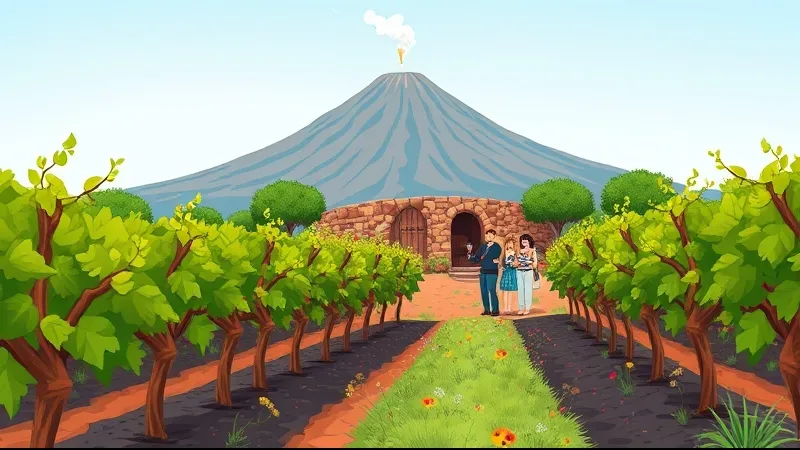
Spring on Etna: A Volcanologist's Wine Tour
My personal guide to tasting volcanic wines among century-old vines — where lava meets the glass
Why I always recommend visiting the vineyards in spring
People come to me to climb to the summit craters, and I love that. But every spring, when the vines on the lower flanks start pushing out their first tender leaves, I make a point of walking through the vineyards before leading anyone up to the top. There's something about that contrast — snow still sitting on the craters above, wildflowers scattered across black lava below — that captures everything I love about this mountain.
Spring, from April through June, is when Etna is most itself. Temperatures settle around 15–22°C during the day. The summer crowds haven't arrived yet. And the winemakers — most of them small family operations — actually have time to sit with you, pour a glass, and tell you the story of what's in it. I've had conversations in those cellars that lasted two hours and felt like twenty minutes.
This is also the best time to understand what makes Etna wine different from everything else in Italy. The DOC Etna designation goes back to 1968 — one of the oldest in Sicily — and the vineyards sit between 400m and 1,100m altitude on soils that I, as a volcanological guide, find genuinely fascinating. This is not metaphorical terroir. It's the real thing: basalt, pumice, volcanic sand, mineral-rich ash from eruptions going back centuries.
Etna is part of the Parco dell'Etna, a UNESCO World Heritage site, and the landscape around these vineyards has a wildness to it that you won't find in Tuscany or Piedmont. That's part of what draws me back to these slopes, glass in hand, every spring.
The grapes that only grow here — and why
I'm not a sommelier, but I've spent enough time with the winemakers up here to understand what makes these varieties special. None of them were brought here for commercial reasons. They evolved on this mountain over centuries, shaped by volcanic soil and altitude, and they don't really work anywhere else.
- Nerello Mascalese — This is the soul of Etna red wine. Roughly 80% of the red plantings on the mountain are Nerello Mascalese. People compare it to Pinot Noir or Nebbiolo — fine tannins, medium body, a transparency that lets you taste the specific ground it came from. When I walk a client through a vineyard and then pour them a glass of Nerello from that same plot, the connection is immediate.
- Nerello Cappuccio — The quieter partner. It blends with Mascalese in Etna Rosso, adding color and a softer fruit quality. You rarely find it bottled alone, but without it, many of the reds would feel incomplete.
- Carricante — The great white grape of Etna, and one that I think is underrated internationally. Its home is on the eastern slope near Milo, where sea air from the Ionian carries a saltiness that you can actually taste in the wine. Citrus, mineral, bright acidity — it ages beautifully. One of my favorite wines to open after a long day on the mountain.
What I find endlessly interesting, as someone who reads volcanic landscapes for a living, is that the soils change dramatically within short distances. The territory is officially divided into contrade — over 130 of them — each with its own geology, altitude, and microclimate, functioning much like Burgundy's climats. The Consorzio Etna DOC now recognizes these on labels, and when you know the contrada, you can start to trace exactly which lava flow the wine came from. That's the kind of detail that makes me love this mountain.
Where I take people — and what each zone feels like
The vineyards wrap around Etna's flanks, and each side of the mountain has a different personality. After years of guiding up here, I have my favorites — but the honest answer is that every zone is worth knowing.
The north: Randazzo, Castiglione di Sicilia, Solicchiata
If I could only take someone to one area for wine, this would be it. The northern slopes hold the most celebrated vineyards on the mountain — altitudes reaching up to 1,100m, ancient lava flows piled in geological layers going back centuries. The wines here have structure and depth that you feel immediately. This is where most of the legendary contrade are concentrated, and standing in those vineyards with the north face of Etna rising above you is a genuinely moving experience.
The east: Milo
This is Carricante country, and in spring it's spectacularly green. The village of Milo sits between 600 and 900m, and the vineyards here catch morning light from the Ionian Sea. The maritime influence is real — you notice it in the wines and you feel it in the air. I always recommend at least one visit to this side if you're serious about white wine.
The south-west: Biancavilla and Adrano
Warmer, drier, lower altitude. The wines are rounder and more immediately approachable. Far fewer tourists come here, which means the tasting experiences tend to be more relaxed and personal. If you want to feel like a local rather than a wine tourist, head south-west.
For a well-designed route through all the zones, the Strada del Vino dell'Etna has good itineraries that connect the main viticultural areas without getting lost on mountain roads.
What the volcano actually does to the wine
This is the part where my job as a volcanological guide and a wine enthusiast genuinely overlap, and I could talk about it for hours.
The soils under these vines are not ordinary agricultural soils. They are the direct product of eruptions — some hundreds of years old, some from flows as recent as the 1800s. By geological standards, they're young, and their mineral composition — rich in potassium, iron, and magnesium, according to research from INGV Osservatorio Etneo and the University of Catania — has no real equivalent elsewhere in the Mediterranean wine world.
The soils are also extremely porous. Rainwater disappears almost immediately through layers of volcanic sand and pumice. Vine roots have to go very deep to find moisture, and that natural stress concentrates everything in the grape — sugar, acid, flavor compounds.
Here's the detail I share with clients that always stops them: many of Etna's vines are ungrafted. The phylloxera epidemic that wiped out European vineyards in the late 19th century largely skipped this mountain, because the sandy volcanic soil prevented the root louse from spreading. Some of these vines have been growing on their own rootstock for well over a century, trained in the traditional alberello bush-vine style that you see scattered across the terraces like small gnarled sculptures.
And altitude does something that I see every day in my work: it creates dramatic temperature swings. The difference between day and night temperatures can reach 15°C. Cool nights slow down ripening, preserve acidity, and let aromatic compounds build gradually over a long season. That's why Etna wines have a freshness and tension that wines from the Sicilian coast simply can't match.
What happens during a wine tour — from my perspective
A typical visit follows a familiar shape, but every producer adds something personal. Here's what you can generally expect:
- Vineyard walk — The best part, as far as I'm concerned. You walk among vines that are often 80 to 120 years old — some older — trained in the alberello style on terraces of dark volcanic stone. In spring you see them waking up: buds swelling, first leaves unfolding, the soil still damp from winter rain. The landscape looks and smells alive.
- Cantina visit — A look at the cellar, fermentation tanks, aging barrels. Many Etna producers use large Slavonian oak vessels or concrete — tools that let the grape speak rather than the wood. It reflects a philosophy you hear from every serious winemaker up here: get out of the way and let the volcano express itself.
- Tasting — Usually 3 to 6 wines, moving from Etna Bianco through Rosato to Rosso, sometimes finishing with a Riserva that has several years behind it.
- Food pairing — Pistachio from Bronte DOP, cured meats, cheeses from the Nebrodi mountains, local olive oil. Some estates offer a full lunch. I won't pretend this isn't one of my favorite parts of the day.
Prices range from €25–€60 for a standard guided tasting up to €80–€150 for premium experiences with food. Spring is the best season for availability — especially at the smaller family estates that can only accommodate a handful of visitors at a time.
My favorite combination: vineyards in the morning, craters in the afternoon
I'm biased here, obviously. But combining a wine tour with a volcano excursion is genuinely one of the best ways to spend a day on Etna, and it's not just because I guide both.
The connection is real. When I lead people up to the summit area and show them a lava flow from the 1600s, then a field of basalt columns from an older eruption, I'm showing them the raw material of the wine they'll taste later. The same geological forces that make this mountain dangerous also make the soils extraordinary for growing grapes. That's a story you feel differently when you've experienced both ends of it in the same day.
The vineyards sit on the lower flanks. The summit craters rise to 3,357m. You can do a morning among the vines and an afternoon on the volcanic terrain, or reverse the order. Either way, you leave with a complete picture of Etna — not just as a wine destination or just as a geological spectacle, but as a living, active system where the eruptions of the past are still feeding the vines of the present.
A certified Guida Vulcanologica does more than keep you safe on the upper slopes — though that matters too, since conditions up there change fast. We read the landscape. We can tell you which lava flow created the ground you're standing on and roughly when it happened. We connect what you're walking through to what ends up in your glass. You can find combined experiences at etnaexplore.com.
When to come — and a note on altitude timing
Each spring month gives you something different, and after years up here I have a clear preference:
- April — Quiet and atmospheric. Fewer visitors, more personal attention from the winemakers. The vines are just beginning to bud, and you might still catch the tail end of almond blossom on the lower slopes. Cooler temperatures at altitude — bring layers.
- May — My personal favorite month on the mountain. The vines are in full vegetative growth, wildflowers are everywhere, temperatures are perfect for long walks outdoors. If you can only come once, come in May.
- June — Long days and warmer temperatures. The vineyards are lush and the evenings are beautiful. Altitude keeps the wine zones comfortable even when the coast gets hot.
One thing I always tell my clients: altitude changes everything about timing. A vineyard at 500m might be two to three weeks ahead of one at 900m. If you visit in April and want to see more advanced vine growth, start low. If you visit in June and want cooler conditions, head north and up.
For harvest — the vendemmia — plan for September to October, with higher-altitude plots going last.
What you'll pay — and where the value is
- Walk-in tasting at smaller estates: Free to €15 — especially possible during quiet spring weeks
- Standard guided tasting: €25–€60 per person — vineyard walk, cellar, 3–5 wines
- Premium with food pairing or lunch: €80–€150 per person — the experience I personally recommend at least once
- Full private day with guide and transport: €150–€300 per person — multiple zones, door-to-door, deep dive into the territory
Retail prices for Etna DOC bottles run €12–€40 for most of the range. Top single-contrada selections go higher, but the everyday Rosso and Bianco offer some of the best value in Italian wine right now. And buying direct from the producer — which most cantinas allow — often means access to wines that never reach shop shelves.
A tradition older than you'd expect
People sometimes discover Etna wine and assume it's a recent trend — a "discovery" by international wine critics in the last two decades. The critics did arrive, and the attention helped, but the tradition here is ancient.
Greek colonists were already growing organized vineyards on these slopes in the 8th century BC, when they settled Sicily's eastern coast. The soils and altitude proved ideal from the very beginning, and wine became a pillar of the local economy. The DOC designation came in 1968, one of Sicily's first.
What followed was a long decline — rural depopulation, cheaper flatland vineyards, a shift away from quality. Many of Etna's high-altitude vineyards were simply abandoned. The old alberello vines kept growing, but no one was tending them.
Then in the early 2000s, something changed. Wine writers started talking about what they called the Etna Renaissance. Producers from outside the region — some from other parts of Italy, some from abroad — came to the mountain and found those neglected old vines still producing extraordinary fruit. A new generation of local winemakers reinvested in their heritage. Today there are over 130 active producers in the Etna DOC, according to the Consorzio. What was once a forgotten corner of Sicilian wine is now one of Italy's most talked-about regions.
I've watched part of that transformation happen from my position on the mountain, and it still gives me genuine pleasure. The same landscape that I love for its geology, its craters, its lava flows — turns out to make exceptional wine. Etna keeps surprising people. That's one of the things I love most about it.
Common questions I get about Etna wine tours
Do I need to book ahead?
Yes, always. Most producers are small operations, and even in spring they fill up. Contact the winery directly or go through an organized tour. Don't just show up.
Is Etna wine expensive?
At retail, most bottles sit between €12 and €40. For the quality — especially the Nerello Mascalese reds — that's genuinely good value. Top contrada selections and Riservas cost more, but the everyday range is excellent.
Can I buy bottles directly from producers?
Almost always yes, and I strongly encourage it. You often find wines that aren't exported or widely distributed. That's one of the real privileges of visiting in person.
What if I don't drink wine?
Come anyway. The vineyard walks, the volcanic landscape, the food, the architecture of the old cantinas — it's all worth experiencing. I've taken non-drinkers on wine tours and they've had a wonderful time.
What should I wear?
Closed shoes with good grip. Vineyard ground is volcanic and uneven. Layers — especially in April and early May, when altitude means temperatures drop faster than you'd expect. The same advice I give for the upper mountain applies here, just less extreme.
Is transport included?
It depends on the tour. Some include pickup; independent visits require your own car. The wine zones are spread across the mountain, and public connections between them are limited. Check before booking.
What if it rains?
Rain in spring on Etna is normal and nothing to worry about. Every producer has indoor tasting rooms and cellars. Honestly, a rainy day in an old stone cantina with a good glass of Nerello has its own particular charm.
Sources
- Consorzio di Tutela dei Vini Etna DOC — Production data, contrade map, DOC regulations
- INGV Osservatorio Etneo — Geological data on Etna's volcanic soils and eruption history
- Parco dell'Etna — Environmental data, altitude zones, protected landscape information
- UNESCO World Heritage — Mount Etna — Landscape recognition and natural heritage documentation
- University of Catania — Department of Agriculture — Terroir studies and viticultural research on Etna's volcanic soils
- Regione Siciliana — Assessorato Agricoltura — DOC regulations and regional wine policy
Before You Book: Quick Planning Checklist
- Check updated weather and volcanic activity conditions for your travel dates.
- Confirm meeting point, start time, and transfer arrangements.
- Request availability early for your preferred date and route.
- Read local safety guidance before excursions.