Cable Car or Hike on Etna? My Honest Guide Advice
Trekking 11 min

Cable Car or Hike on Etna? My Honest Guide Advice

After hundreds of ascents, here's what I tell every visitor who asks me the same question

Cable Car or Hike on Etna? My Honest Guide Advice
Published on 2026-04-2311 min

The question I hear every single week

"Vincenzo, should we take the cable car or walk up?" It comes from families on WhatsApp the night before their visit, from solo trekkers I meet at Rifugio Sapienza at dawn, from cruise passengers with exactly four hours. My answer is never automatic — because the right choice depends entirely on the person asking, not on the mountain.

Let me tell you what I've learned from leading hundreds of people up this volcano. Both the Funivia dell'Etna and a proper hike can give you a genuinely extraordinary day. They just give you different versions of it.

Before I break down either option, though, one rule that applies to absolutely everyone: to go above roughly 2750 m — the summit crater zone — you must be accompanied by an authorized Guida Vulcanologica. This is Sicilian regional law, and it exists because up there, Etna is an active, breathing system. The INGV Osservatorio Etneo monitors it around the clock for a reason. I carry real-time information on gas concentrations and eruptive behavior every time I step above that threshold with a group.

The cable car: what it actually is and where it takes you

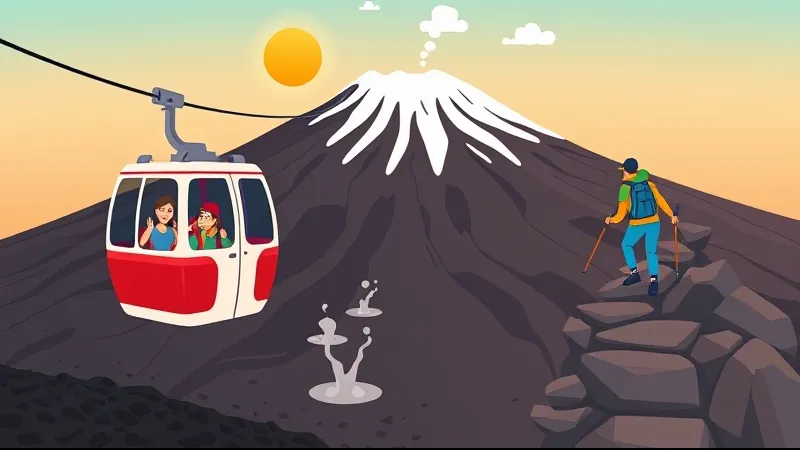
The Funivia dell'Etna is the only one on the whole volcano. It lifts you from Rifugio Sapienza on the south flank at 1910 m to La Montagnola station at 2500 m — a 590-metre gain in roughly fifteen minutes. From the top station, if you want to go higher, you transfer onto a specialized 4x4 Unimog that grinds up to about 2900 m near the Torre del Filosofo area.

Rifugio Sapienza itself is worth knowing: it's the main southern gateway, reachable by car or by the AST bus from Catania. You'll find restaurants, parking, the cable car base, and right there in front of you — the Monti Silvestri, two spectacular secondary craters born from the 1892 eruption that you can walk around for free. I often send people there first while we wait for the cable car queue to thin out.

For current fares and schedule, check directly with the Funivia dell'Etna. The Parco dell'Etna also keeps useful access information updated.

What does the cable car cost?

At the time I'm writing this, the published rates are:

  • Round-trip cable car only (Sapienza to La Montagnola and back): €54 per adult
  • Combined package — cable car plus 4x4 Unimog plus official guide up to 2900 m: €82 per adult
  • Reduced fares for children below a certain age

These numbers can shift seasonally. Always confirm directly on the official website before you arrive — I've seen group discounts appear and disappear with little notice. For excursions that push beyond 2900 m with an independent authorized guide, pricing is set by the guide directly.

Where can you start a hike, and what does it cost you?

Here's something most visitors don't realize: hiking Etna is free. The trail network maintained by the Parco dell'Etna charges no admission. You pay for parking — that's it, below the summit guide requirement.

The three starting points I use most with clients:

  • Rifugio Sapienza (1910 m, south) — the busiest trailhead, great direct access to Monti Silvestri and routes climbing toward the Valle del Bove. You'll share the path with cable car visitors early in the day.
  • Piano Provenzana (1810 m, north) — my personal favourite for atmosphere. The forest here was ripped apart by the 2002 eruption, and watching the pine trees regenerate through hardened lava gives you a living geology lesson before you've even started climbing. Almost no queues, ever.
  • Schiena dell'Asino viewpoint trail — for the panorama above Valle del Bove alone, I consider this one of the most spectacular short walks in all of Sicily.

For shorter routes suitable for less experienced walkers, the Monti Silvestri loop and the Monte Nero degli Zappini nature trail are marked, educational, and genuinely beautiful. Check the Parco dell'Etna for current trail maps and any closures before heading out.

Why I sometimes tell people to take the cable car

I won't pretend hiking is always the right answer. Here's when I genuinely recommend the cable car:

  • You're travelling with children under around 8 or 9 — controlled exposure, quick descent if someone starts feeling off, and the whole round-trip fits inside a morning
  • You have a hard deadline (cruise, afternoon flight) and need to be back at a specific time
  • Someone in your group has knee problems or limited cardiovascular fitness — the climb on loose volcanic scree is unforgiving
  • You simply want to see the high flank once and understand what you're looking at, without a multi-hour commitment

The cable car gives you the views. On a clear day the Ionian coast stretches below you and the crater zone fills the sky above. That's real, and it's impressive.

What it doesn't give you: the transition through the vegetation belts, the silence of the lava desert, the chance to put your hands on a flow and feel the texture of a geological event. That's what walking gives you.

Why most serious visitors end up hiking

After years on this mountain, I'd say seven out of ten people who've already been to Etna once come back specifically to hike. Here's what they tell me they missed the first time:

  • The endemic ginestra — Mount Etna broom — carpeting the mid-altitude slopes in acid yellow. There is no better foreground subject for a wide-angle photograph on this volcano.
  • The Betula aetnensis, the Etna birch, a relict species that exists nowhere else on earth. You pass through small groves of them on the north side trails and most people have no idea what they're looking at until I explain it.
  • The absence of infrastructure in the frame — if you care about photography, the cable car corridor is full of fencing, stations, and Unimog tracks. The free hiking zones are clean.
  • Piano Provenzana in the early morning, when the north side is still in shadow and the summit craters are catching the first light. I've stood there hundreds of times and it still stops me.

Altitude: what you actually reach with each option

Let me be precise, because people often confuse marketing language with actual elevation:

  • Cable car alone: gets you to 2500 m at La Montagnola
  • Cable car + Unimog: reaches roughly 2900 m in the Torre del Filosofo area
  • Guided summit excursion from 2900 m: depending on current volcanic activity, you can approach 3300 m and sometimes higher
  • Hiking from Sapienza or Piano Provenzana on foot: you also reach 2900–3000 m without any mechanical help, if you're fit and the conditions allow

Etna's true summit sits around 3400 m — the Voragine crater and the North-East Crater trade the title of highest point depending on how much new cone material recent activity has built up. The INGV Osservatorio Etneo updates exact morphology in its weekly bulletins.

Do you need an authorized guide for the summit? Yes — here's why it matters

I want to be direct about this because I see a lot of vague information online. Above approximately 2750 m, Sicilian regional law requires an authorized Guida Vulcanologica. This is enforced by the Collegio Regionale delle Guide Alpine Siciliane in coordination with the Parco dell'Etna and Civil Protection. It applies whether you took the cable car or walked every metre on foot.

I'm not going to tell you it's just bureaucracy, because it isn't. Up there you're exposed to ballistic ejecta — rocks thrown during small explosions — volcanic gases including SO₂ and CO₂ that pool invisibly in depressions, and the possibility of sudden eruptive escalation. I carry helmets and gas masks for my clients on every summit ascent. I maintain live contact with INGV. I know which flank to take based on today's wind direction and the tremor readings from this morning.

The summit is worth every regulation written to protect it.

Families on Etna: what I actually tell parents

For kids under about 10, I nearly always suggest the cable car as the primary option. The ascent is quick, you control the exposure, and if a child develops altitude symptoms — headache, nausea, sudden fatigue — you descend immediately without having invested three hours of uphill effort.

Two things I always warn parents about, regardless of season:

  • Altitude effects above 2500 m hit young children faster than adults. Watch for it, take it seriously, go down if in doubt.
  • Wind chill: the temperature at 2500 m can easily be 15°C colder than Catania on the same afternoon. I've watched families arrive at La Montagnola in summer shorts completely unprepared. Layers are mandatory, not optional.

For older children and teenagers, the Monti Silvestri loop and Monte Nero degli Zappini trail are ideal introductions — well-marked, educational, genuinely engaging without requiring any special fitness.

The smartest option: combine both

This is actually the approach I recommend most often when someone has a full day. Take the cable car up, hike down. The specific route I prefer: cable car to La Montagnola, then descend along the rim of the Valle del Bove — a vast horseshoe depression formed by an ancient flank collapse — or drop back toward Sapienza via the Schiena dell'Asino route.

Why this works so well: you skip the most physically punishing part (the steep ascent on loose scree) while keeping everything that makes hiking on Etna special — the geological detail, the silence, the photography, the gradual transition back through the vegetation zones. The descent also reveals features you simply can't appreciate going uphill.

Guided sunset descents are something several of us offer locally. You reach the upper station in afternoon light, walk down as the sun drops toward the Ionian horizon, and finish with the whole lava field turning gold beneath you. If I'm honest, it's one of the best two hours this volcano offers.

How seasons change everything

Etna is open year-round, but what you experience varies enormously:

Summer (June–September): both options running fully. For hiking, start before 8am — the afternoon brings heat and, especially in August, sudden electrical storms above 2000 m. Cable car queues in August can stretch past an hour at peak time.

Winter (December–March): the cable car keeps operating and doubles as access for the two Etna ski areas — Etna Sud near Nicolosi and Etna Nord near Linguaglossa. Winter hiking above the snowline is a completely different discipline requiring crampons, ice axe, and in my view, an experienced winter guide. Spectacular, but not casual.

Spring and autumn are when I take my most enjoyable groups. Mild temperatures, long daylight, almost no crowds on the north side. If you have any flexibility in your travel dates, aim for April–May or September–October.

Volcanic activity: the variable no one can ignore

Etna is one of the most continuously active volcanoes on the planet. That's not a warning — it's the reason people come from everywhere in the world to see it. But it does mean plans change.

During a paroxysm — a short, intense eruptive episode — Civil Protection can close the high-altitude zone entirely, regardless of whether you planned to walk or ride. The cable car suspends service when ash falls on the cables or when wind exceeds safe operating limits. Trails on the directly affected flank close; often the opposite side stays open.

My routine check before any ascent:

  • INGV weekly bulletin at ct.ingv.it — the most authoritative source
  • Civil Protection Sicilia advisories
  • Nicolosi and Catania municipal ordinances if there's been recent activity

Etna earned its UNESCO World Heritage inscription in 2013 precisely because of this ongoing activity. The mountain's unpredictability is inseparable from its magnificence. You come prepared, you stay informed, and you respect when it says no.

What to pack — my actual checklist

Non-negotiable for everyone, cable car included:

  • Closed hiking boots or at minimum sturdy trainers — no sandals, no exceptions. I've turned people back at La Montagnola for wearing flip-flops.
  • Windproof outer layer
  • A warm mid-layer (fleece or light down) — even in July at 2500 m
  • Sunglasses with UV protection — lava and snow both reflect intensely
  • SPF 50 sunscreen
  • At least 1.5 litres of water per person
  • Sun hat in summer, warm hat above 2500 m
  • Light gloves at altitude

For hikers specifically:

  • Trekking poles — volcanic scree on the descent destroys knees without them
  • Headlamp if you're doing a sunrise or sunset route
  • GPS app with offline maps downloaded
  • Small first-aid kit

For summit excursions: helmet and gas mask are always provided by me. You don't need to source these yourself.

Common questions I get asked

Can you hike Etna completely independently?

On all lower and mid-altitude trails, absolutely yes. Rifugio Sapienza, Piano Provenzana, Monti Silvestri, Monte Nero degli Zappini, Schiena dell'Asino — all freely accessible without any guide. The summit crater zone above approximately 2750 m is the only area that legally requires an authorized Guida Vulcanologica.

What if the cable car is closed when I arrive?

It happens — wind, visibility, ash, or activity can suspend service with little warning. In that case, Funivia dell'Etna typically refunds or reschedules according to their policy. Your day isn't lost: the Monti Silvestri and the lower Sapienza trails are still excellent, and if the weather on the south is the problem, Piano Provenzana on the north side often has different conditions entirely.

Is altitude sickness a real concern on Etna?

Mild effects — headache, slightly shortened breath, reduced appetite — are common above 2000 m, especially for people who've come straight up from sea level. True altitude sickness below 3000 m is rare. Hydrate, go up gradually, and descend immediately if symptoms don't improve. Children and anyone with cardiovascular history should be more cautious above 2500 m.

Is the cable car accessible for people with mobility limitations?

The base and upper stations have partial accessibility, but the terrain at 2500 m — loose volcanic gravel, uneven platforms, frequent strong wind — makes independent movement genuinely difficult. Contact Funivia dell'Etna directly before your visit to discuss specific needs. The summit terrain cannot be accessed by wheelchair under any conditions.

The sources I rely on — and you should too

I read these before every excursion, and I encourage you to check them before you book:

If you'd rather skip the research and just show up ready, write to me directly. I'll tell you what the mountain is doing this week, which route suits your group, and what the summit looked like on my last ascent. That's what I'm here for.

Before You Book: Quick Planning Checklist

  • Check updated weather and volcanic activity conditions for your travel dates.
  • Confirm meeting point, start time, and transfer arrangements.
  • Request availability early for your preferred date and route.
  • Read local safety guidance before excursions.

Plan and book links