Etna Webcams: How I Read Them Every Morning
My personal routine for watching the mountain before every excursion โ the cameras I trust, what the images actually mean, and the mistakes I see visitors make

The first thing I do every single morning
Before I drink my coffee, before I check my phone messages, I open the webcams. It has been my ritual for years. Etna is not a polite volcano that sends you a calendar invite before doing something interesting โ it moves on its own schedule, and part of my job as a certified volcanological guide is to already know what it did overnight by the time my clients are still asleep at their hotel.
The cameras I trust are the ones run by INGV-Osservatorio Etneo in Catania โ Italy's national geophysics and volcanology institute, the same people who monitor the volcano around the clock for Civil Protection. I also have my own live webcam pointed directly at the summit craters, available on etnaexplore.com and vincenzomodica.com โ I set it up precisely because I wanted a clean, uncluttered view of the South-East Crater, the Voragine and the North-East Crater without ads, pop-ups or the three-second lag that plagues most aggregator sites. If you want to check summit conditions before joining one of my tours, that is the one to bookmark.
The INGV portal is at ct.ingv.it. It is free, it has no paywall, and the images are exactly what the duty volcanologist is watching right now. There is no better source.
The cameras I actually use โ and why each one matters
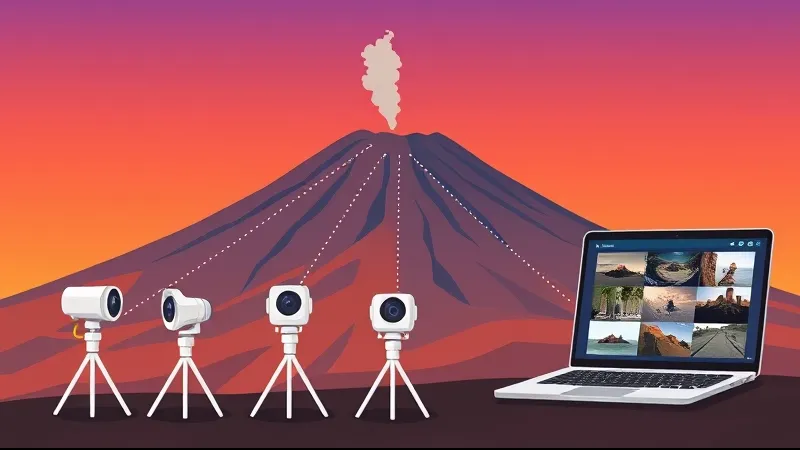
People often ask me which single webcam is the best. My honest answer: it depends on where the activity is, and you should always use at least two. Here is how I think about each station.
Montagnola โ EMOV, 2600 metres, south flank. This is the workhorse. It sits closest to the summit craters of any public camera, and when Etna is doing something spectacular โ a lava fountain, a Strombolian sequence, a tall gas column from the Voragine โ Montagnola usually captures it best. I watch this one first every morning. The trade-off: at 2600 metres, it gets buried in ash during intense eruptions and completely iced over in winter. The moments you most want a clear image are exactly the moments it tends to go dark.
Schiena dell'Asino โ ESV, 1900 metres, southeast. A wide, panoramic view of the southeast flank. I use this when I am planning an excursion toward the Valle del Bove rim, because it gives me a sense of cloud height and visibility across the whole eastern face. It is also a good cross-check: if Montagnola shows something but Schiena dell'Asino shows nothing, I know the activity is localised at the summit rather than spreading down the flank.
Monte Cagliato โ EMCV, 1160 metres, east. This one looks west, straight into the Valle del Bove. I pay close attention to it whenever I am guiding groups toward the Valle, because it is the only camera that shows you whether fresh lava is actually moving through the interior. One of Etna's most common eruptive scenarios is a vent opening on the flanks and sending a flow into the Valle โ Monte Cagliato is where you see that first.
Bronte โ EBVH, west side. Many people ignore the west flank. I do not. Etna's activity shifts sides more than most people realise, and Bronte gives you a completely different angle. When I have clients coming from the Bronte or Randazzo side, this is my reference for their approach conditions.
Milo โ EMV, east, low altitude. A lower-angle complement to Monte Cagliato. Useful for atmospheric conditions on the eastern approach and for confirming what the higher camera is showing.
Visible, thermal, SOโ โ which feed to open and when
This distinction is genuinely important, and I am surprised how often even experienced volcano-watchers get confused by it.
The visible-light cameras show what your eyes would see if you were standing there. A beautiful daytime plume, a glowing fountain at dusk, the grey bloom of an ash cloud drifting southeast. They are intuitive and easy to read โ but they are blind after dark, and a layer of cloud turns every image into a grey wall. If it is overcast, visible cams tell you almost nothing about what the volcano is doing.
The thermal infrared cameras detect heat, not light. They see through smoke, through thin cloud, through the dark of a Sicilian winter night. An active vent that looks completely invisible on the visible cam often blazes bright white on the thermal feed. These are the cameras I rely on when I am trying to assess overnight activity or when the summit is wrapped in cloud. If I had to choose only one type for serious monitoring, thermal wins every time.
The UV/SOโ cameras measure sulphur dioxide flux in the plume. They look like greyscale absorption maps and are honestly not something most visitors need to interpret directly. What matters is the number that comes out of them โ SOโ flux in tonnes per day โ which goes into the INGV weekly bulletin. When that number spikes sharply, it usually means something is happening underground even if the surface looks quiet. I pay attention to those figures, even if the camera image itself means little to an untrained eye.
My practical rule: at night or in poor weather, open the thermal feed immediately and do not waste time with the visible cam. During the day in clear conditions, start with visible (Montagnola), then cross-check with thermal to confirm what you are reading.
What I actually see in a webcam frame โ and what most people get wrong
I have guided hundreds of people over the years, and one thing I notice is that visitors often misread what the cameras show them. So let me give you my honest field translation.
A white, puffy plume rising gently from the summit? That is water vapour and condensed volcanic gas โ normal degassing, nothing alarming. Etna breathes like this even on its quietest days. A white plume alone is not news.
A grey or brownish plume is different. Grey means ash โ the volcano is fragmenting magma, which means Strombolian activity or an ash emission episode. This is something I note, because depending on wind direction it affects which routes I choose for the day.
A dense black column rising fast is an energetic eruption. Fast movement, dark colour, and a column that keeps climbing โ this is usually associated with lava fountains. On those mornings, I adjust everything.
An orange or red glow at night on a visible cam means incandescent material at the vent. On a thermal cam, the same thing appears as a brilliant white hotspot โ sometimes almost overexposed. I have woken up at 3am to check these. On memorable nights, I have driven up to a higher vantage point to watch in person.
Here is the mistake I see most often: people see a frame completely covered in white and think it is a massive gas emission. Nine times out of ten it is ordinary cloud or fog. The giveaway is that a real plume has a source โ a defined point at a crater. Meteorological cloud is uniform across the entire frame, touching the edges, blurring the foreground. Train your eye to notice that difference and you will save yourself a lot of false alarms.
Why I always read the INGV bulletin before watching the cameras
A webcam image without context is a guessing game. I learned this early in my career: I would watch a camera, see something unusual, form a hypothesis, and then read the bulletin and discover I had been looking at exactly the wrong thing. The correct workflow โ which I now teach anyone who asks โ is bulletin first, cameras second.
The INGV weekly multidisciplinary bulletin is a free document that tells you: which craters are active, what type of activity is occurring (degassing, Strombolian, lava fountain, lava flow), how high the plumes were, what the SOโ flux was, and what the volcanic tremor looked like. When you then open the cameras with that context in your head, suddenly the image makes sense. A camera showing an apparently quiet summit while the bulletin says "ongoing Strombolian activity at the Voragine" almost always means cloud cover between the camera and the vent โ not that the bulletin is wrong.
The bulletins are published on the INGV bulletin page. I read them every week without fail. They are also the source I recommend when journalists or travel writers ask me what is happening on the volcano โ I send them there, not to social media.
Why a camera sometimes goes black โ and why it is almost never a drama
I get messages from followers saying "the webcam is offline, is something terrible happening?" Almost always: no.
Ash fall is the most ironic cause. During an eruption, the cameras closest to the summit get coated in fine ash and go dark โ precisely when you most want to see. This is just physics. INGV technicians clean the optics when it is safe to do so, and thermal cameras are more resistant to this problem than visible ones.
Lightning is another culprit. Etna generates impressive electrical storms during paroxysmal phases, and a strike near a high-altitude station can knock out the power or the radio link for days. Snow and ice in winter are an obvious issue at Montagnola. And occasionally, network repeaters that sit on exposed ridges simply fail, and a single failed repeater can take multiple cameras offline at once since they share the same transmission chain.
During serious eruptive episodes, INGV prioritises restoring at least one thermal feed covering the active sector. They also publish supplementary reports that explain camera outages. So if a camera is dark and you want to know why, check the INGV portal for updates โ there is almost always an explanation rather than silence.
Cameras are free. Anyone charging you is charging you for nothing
I want to be direct about this because I have seen clients arrive after paying for some "premium volcano live cam" service that turned out to be exactly the same INGV public feed with a watermark and a paywall in front of it.
Every INGV scientific webcam is free. It is funded by Italian public money โ the Ministry of University and Research and the Civil Protection system. The public already paid for these cameras. There is no login, no subscription, no app required. If a website asks you for money to watch Etna live, close the tab and go directly to ct.ingv.it instead. My own webcam on etnaexplore.com and vincenzomodica.com is also completely free โ I put it up so people can check summit conditions before joining a tour, not to monetise Etna's image.
My pre-excursion webcam routine, step by step
This is exactly what I do the evening before and morning of every guided excursion. Feel free to steal it.
- The evening before: read the latest INGV bulletin. Check the aviation colour code โ green means routine activity, yellow means elevated unrest, orange and red mean significant eruption in progress. This sets my mental baseline.
- Then open Montagnola (visible cam if it is still daylight, thermal if not). This answers the immediate question: what is the summit doing right now?
- Cross-check with Schiena dell'Asino or Monte Cagliato depending on which side I am guiding. Two cameras, two angles. Conclusions drawn from one camera alone have embarrassed me before.
- Check volcanic tremor amplitude graphs on INGV's monitoring page. A rising tremor signal in the evening often precedes an increase in surface activity by several hours. I have cancelled tours based on an upward tremor trend more than once โ and been glad I did.
- Morning of the tour: same sequence, faster. I am confirming that what I expected from the evening is still true, or updating my picture if the volcano did something overnight.
- For aviation context when there is an ash plume: I check the Toulouse VAAC advisories to understand wind direction and ash dispersal โ useful even when I am not flying, because it tells me where ash is heading and whether the summit approach will be unpleasant.
This whole process takes me about ten minutes once you know what you are looking at. At first it takes longer, but you develop an eye for it quickly.
Which camera to watch the night before your tour โ by departure point
If you are joining one of my excursions, here is exactly which cameras give you the most relevant picture.
Departing from the south side at Rifugio Sapienza (1900 m)? Your cameras are Montagnola and Schiena dell'Asino. They show conditions directly above your starting point. If both show cloud sitting at the summit on the evening before, expect limited visibility above 2900 metres. Not necessarily a reason to cancel โ some of the most dramatic Etna experiences happen in cloud โ but good to know.
Coming from the north side at Piano Provenzana (1800 m)? Watch the Bronte cam and any available Linguaglossa-side feed. The north flank genuinely has different weather patterns from the south. A south side buried in cloud does not always mean the north is the same โ and vice versa. I have guided clear-sky tours on the north while the south was completely socked in.
For Valle del Bove excursions on the east side: Monte Cagliato is your primary reference. Check it for visibility into the Valle and โ importantly โ to confirm there are no active lava flows moving through the interior that would change our route.
FAQ โ Questions I am asked most often about the webcams
Which single Etna webcam gives the best view of the summit craters?
For the INGV network, Montagnola (EMOV) at 2600 metres is the closest public scientific camera. But for a direct, clear view of the South-East Crater, the Voragine and the North-East Crater without the clutter of a data portal, I am biased toward my own camera on etnaexplore.com โ I designed the framing specifically for exactly this purpose. Use both together for the fullest picture.
Can webcams tell me if Etna is about to erupt?
No โ and I want to be honest about this because it matters. Webcams confirm what is already happening visually; they cannot predict what is about to happen. Even INGV's full monitoring network โ seismicity, ground deformation, gas geochemistry, infrasound โ can support only short-term probabilistic assessments, not precise predictions. A camera shows you the present. For any hint about what might happen next, you need the bulletin plus the tremor graphs plus a fair amount of experience.
The image is completely black โ has something gone wrong?
Almost certainly not. If it is nighttime, you are looking at a visible-light camera โ switch to a thermal feed to see ongoing activity. If it is daytime and the image is black or uniformly white, there is probably a temporary outage or heavy ash on the lens. Check INGV's portal for a status note; they are usually transparent about technical problems.
Is there a place to watch recordings of past eruptions?
INGV does not maintain a public video archive of its scientific cameras. For documented eruptive episodes, their supplementary reports include selected camera frames. My webcam streams live on etnaexplore.com and vincenzomodica.com. For recorded footage of major eruptions, the INGV YouTube channel publishes highlights when activity is significant.
Can I use a webcam screenshot in an article I am writing?
INGV images are produced by a public research institution and are generally usable with attribution to "INGV-Osservatorio Etneo". For anything beyond editorial use โ commercial redistribution, broadcast at scale โ contact INGV directly. Their contact details are on the official site.
Sources I use and recommend
- INGV โ Osservatorio Etneo (official portal)
- INGV Weekly Multidisciplinary Bulletins
- Smithsonian Global Volcanism Program โ Etna
- Toulouse VAAC โ Volcanic Ash Advisory Center
- Parco dell'Etna โ official site
- UNESCO World Heritage โ Mount Etna
Etna has been my classroom, my workplace and, honestly, my obsession for more years than I can count. The webcams are one small window into a system that is far larger and more complex than any single image can convey. Use them with the bulletins, develop your eye over time, and treat them for what they are: a live feed into the finest volcano monitoring network in Europe. And if you want to see the mountain in person with someone who reads these cameras every single morning โ our guided Etna tours leave from both the south and north sides year-round.
Before You Book: Quick Planning Checklist
- Check updated weather and volcanic activity conditions for your travel dates.
- Confirm meeting point, start time, and transfer arrangements.
- Request availability early for your preferred date and route.
- Read local safety guidance before excursions.