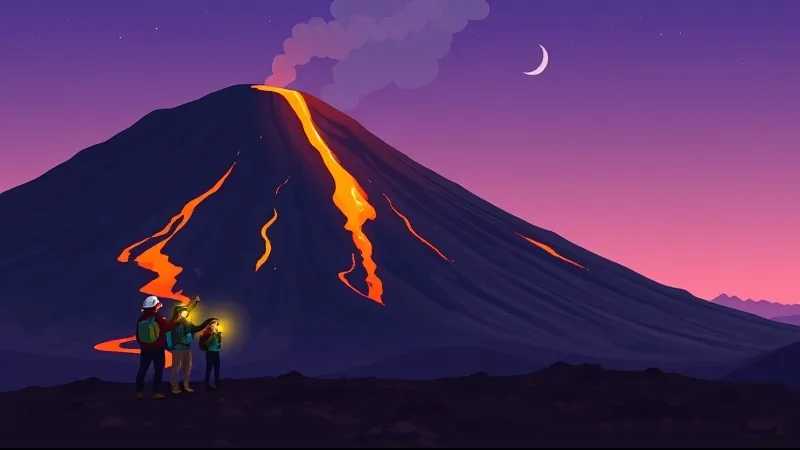
Watching Lava on Etna: What I Tell My Guests
Trekking 11 min

Watching Lava on Etna: What I Tell My Guests

A volcanological guide's honest account of the best spots, the real risks, and what it actually takes to stand near flowing lava on Europe's most active volcano.

Watching Lava on Etna: What I Tell My Guests
Published on 2026-05-0811 min

The honest answer about lava on Etna

I get this question every single week: "Will we see lava?" And I always give the same honest answer — it depends. Not on luck, not on the season, but on what Etna is doing right now. The volcano doesn't keep a schedule. It doesn't care about your holiday dates.

What I can tell you is this: after years of guiding on these slopes, I know exactly where to stand, when to go, and what to look for. There's a big difference between glowing lava — the red incandescence you can spot inside summit craters on most clear nights — and flowing lava, the real thing, moving downhill like a slow river of fire. The first is relatively common if you know where to look. The second requires an actual eruption in progress. I'll walk you through both.

The INGV-Osservatorio Etneo in Catania monitors the volcano around the clock and publishes real-time bulletins. That's my first read every morning before I decide the day's route. When flows are active, the best observation altitudes are generally between 1,800m and 2,900m, from a handful of viewpoints I'll describe below — always with a certified guide, for reasons that go beyond bureaucracy.

How Etna actually behaves — and why it matters for your visit

People often imagine a volcano as something that either explodes dramatically or sits completely dormant. Etna is neither. It's more like a living thing with moods. In all my years here I've seen it go from a quiet, gently steaming mountain to a full paroxysm with lava fountains over a kilometer high — and back again — within days.

The activity splits into two main types. Summit activity happens at the four main craters clustered near the 3,357m peak — Voragine, Bocca Nuova, the North-East Crater, and the South-East Crater. Some level of degassing or mild explosion is almost always happening up there. Then there are flank eruptions, which are rarer and in some ways more spectacular: fissures crack open lower on the volcano's sides and pour out lava flows that can travel for kilometers before cooling. The 2001 and 2002–2003 eruptions are the ones I describe most often to guests because their black fields are still dramatically visible today.

The INGV classifies eruptive behavior into Strombolian activity (frequent low-energy blasts throwing incandescent material), paroxysmal episodes (intense short-lived crises with towering lava fountains), and effusive flows (lava emerging and moving downslope). Each type demands a different approach from me as a guide.

My go-to viewpoints — and why the "best" one changes daily

I want to be direct here: there is no permanently "best" spot to watch lava on Etna. The right viewpoint on any given day depends on wind direction, which vent is active, and where the Civil Protection has drawn the exclusion zones. That said, here are the areas I use most:

  • Piano Vetore (1,750m, south flank) — a wide-open meadow with long sightlines across the southern slopes. Good for distant observation when the South-East Crater is putting on a show.
  • Rifugio Sapienza area (1,910m, south) — the main southern hub, with cable car infrastructure and the broadest views of the summit cone. My starting point for most day excursions.
  • Piano Provenzana (1,810m, north) — the northern gateway, much quieter than the south side and beautifully positioned for any activity on the north and northeast flanks. My personal favourite for atmosphere.
  • Schiena dell'Asino ridge — a dramatic natural balcony overlooking the Valle del Bove. When lava flows east into that caldera, this is the place to be.
  • Valle del Bove rim — the giant amphitheater on the eastern side that catches most flank flows. When a fissure opens facing east, I bring guests here at sunset and nobody goes home disappointed.

What I want you to understand is that a viewpoint I used last Tuesday may be inside a closed exclusion zone by Friday. The Parco dell'Etna and Civil Protection update these zones in real time, and the Carabinieri Forestali enforce them. Local knowledge — real, current, daily-updated knowledge — is not a luxury here. It's what keeps you safe and legal.

The guide requirement: it's the law, and it saved lives

Let me be straightforward about something that tourism websites often gloss over. Italian law — specifically Legge 6/1989 and the Sicilian Region's implementing regulations — requires that anyone going above 2,500m on Etna be accompanied by a certified Volcanological Guide registered with the Collegio Regionale Guide Alpine Sicilia. Not recommended. Required. Fines for non-compliance are real and they are enforced.

But honestly, the law is the least of the reasons I believe in this rule. I've seen what happens when people go up unguided. I've assisted in rescue operations. The dangers on Etna are not the dramatic, obvious ones — they're subtle. A depression in the ground that fills invisibly with CO₂, heavier than air, waiting for someone to step in. A lava crust that looks solid but is hollow above a still-molten flow. A shift in wind that suddenly pushes sulfur dioxide directly at you.

What I actually do as a guide on a lava excursion:

  • Check INGV bulletins two or three times before departure and adjust the route accordingly.
  • Carry gas masks, helmets, and a first-aid kit for every person in the group.
  • Stay in direct contact with park rangers about current exclusion zones — sometimes I know before the updates go online.
  • Read the mountain's signals in real time: changes in the sound or smell of degassing, variations in tremor, shifts in the plume direction.
  • Maintain radio contact with mountain rescue throughout every summit excursion.

The rules exist because people were hurt before they existed. I've led hundreds of excursions on Etna and I take that responsibility seriously every single time.

Up at the summit craters: the most intense experience I can offer

When conditions allow — INGV alert level at green or yellow, exclusion zones permitting — I take guests above 2,900m to the summit craters. It's an experience I struggle to describe adequately in words.

The smell hits you first: sulfur, heavy and unmistakable, the breath of the earth. Then the sound — a low, constant hiss from Bocca Nuova, sometimes punctuated by a deeper rumble from Voragine. Standing at the rim of Bocca Nuova on a clear night, looking down into a glowing magma column, is one of the most humbling things I've witnessed. The North-East Crater, the highest point at 3,357m, degasses with a constant low rumble that you feel more than hear. The South-East Crater — the youngest and most temperamental of the four — is where most paroxysms originate.

This is not a comfortable environment. You're wearing a helmet, a gas mask or FFP3 respirator, and multiple layers in temperatures that can be well below zero even in August. But the reward is an encounter with active geology that exists nowhere else in Europe at this level of accessibility. I've watched scientists from volcanology institutions have the same wide-eyed reaction as first-time visitors. Etna doesn't care about your credentials — it's equally extraordinary for everyone.

Day or night: what each experience actually gives you

I run both, and I recommend both to anyone who has the time. They're genuinely different experiences, not just the same thing in different lighting.

At night, lava reveals itself completely. What looks like a dark, dusty rock field at noon becomes a ribbon of red-orange fire after dark. Incandescent flows that are almost invisible in daylight glow intensely once the ambient light drops. If there's any active lava when I take guests out after sunset, the gasps are immediate and involuntary. Lava emerges at between 700°C and 1,200°C — your eye can only properly register that incandescence in low-light conditions.

During the day, you're reading a different book. You see the morphology of fresh flows, the textures of cooling lava — ropy pahoehoe, jagged aa — the vivid rust and yellow of oxidized cinders around degassing vents, and the full sweep of the landscape in context. You understand the scale of what you're standing on. For first-time visitors, I often suggest a combined itinerary: arrive in the afternoon, explore the geology in daylight, and stay for the show after sunset.

What to wear and carry — no shortcuts here

I'm blunt with guests about equipment because I've seen what happens without it. Etna's lava fields are essentially natural glass — fresh volcanic rock will shred soft-soled shoes in minutes. Here's what I require or strongly recommend:

  • Sturdy hiking boots with rigid soles — non-negotiable. Not trail runners. Real boots.
  • Helmet — mandatory for summit excursions near active vents. I provide them.
  • Gas mask or FFP3 respirator — for SO₂ and HCl when approaching degassing areas. I provide these too, but confirm when you book.
  • Windproof jacket and warm layers — summit temperatures are cold year-round. Wind gusts above 3,000m regularly exceed 80 km/h. I've seen guests shivering in shorts in July.
  • Headlamp — both hands free on uneven volcanic terrain at night. Essential, not optional.
  • UV sunglasses and sunscreen — UV intensity at altitude is significantly higher than at sea level, and the pale lava reflects it straight back at your face.

WHO air quality thresholds for sulfur dioxide can be exceeded in the plume around active vents. This is not theoretical — I carry a gas monitor on summit excursions precisely because the numbers sometimes surprise even me.

How I check whether lava is flowing before I take you out

Every morning starts the same way: INGV-Osservatorio Etneo bulletins on ct.ingv.it. These are the gold standard — written by the scientists who instrument the volcano, published in language that's technical but readable, covering summit activity, tremor amplitude, and any active flows. I've been reading them long enough to understand the patterns.

I also watch the LAVE webcam network, which has cameras pointing at the summit and flank areas. On days when the summit is cloud-covered, the webcams sometimes show what's happening through breaks in the weather. The Toulouse VAAC publishes ash advisories for aviation that give a useful real-time picture when plumes are significant.

The alert color system is simple: green (background), yellow (elevated unrest), orange (heightened activity), red (major eruption). I plan above yellow only with extreme caution and always in direct coordination with park rangers.

One practical warning: be very skeptical of viral social media videos claiming "Etna is erupting right now." I've seen the same spectacular footage recirculate multiple times over several years. Before you change your plans based on a video a friend sent, check ct.ingv.it. That's the only source I trust.

North side or south side: my honest take

I know both flanks intimately and I genuinely love them for different reasons.

The south side, based at Rifugio Sapienza (1,910m), is more developed — cable car, restaurants, bigger parking, faster access from Catania (about an hour). It's the practical choice for guests on tight schedules or staying on the Ionian coast. The infrastructure means more crowds, particularly in summer and on weekends.

The north side, from Piano Provenzana (1,810m), is where I go when I want to feel the mountain rather than manage logistics. It's quieter, wilder, and sits right on the edge of the 2002–2003 lava fields — thick black flows that buried part of the original ski station and reshaped the northern landscape in ways still strikingly visible today. Photographers almost always prefer it. The silence up there on a weekday morning, with just the wind and the distant rumble of the summit — that's the Etna I fell in love with.

The practical rule: the active vent decides. If a fissure opens on the northeastern flank, I'm heading north and east. If the South-East Crater is in paroxysm, the south side and Valle del Bove rim are where the action is. This is exactly the kind of real-time judgment that makes a local guide worth having.

The historical lava fields: Etna even when she's resting

Here's something I tell every guest who worries about visiting during a quiet period: Etna never really disappoints, because the mountain itself is a frozen record of centuries of eruptions. Even with no active flows, walking these lava fields is extraordinary.

The ones I take people to most often:

  • 1669 — the biggest historical eruption, whose flow reached Catania and partially buried the city walls. You can still see the boundary in the urban fabric today.
  • 1981 — northern flank, came within meters of Randazzo. The townspeople still talk about it.
  • 1992 — the year they tried to divert lava away from Zafferana Etnea with bulldozed earthworks and concrete barriers. It half-worked, and the story is fascinating.
  • 2001–2002 — extensive southern and northeastern fields with excellent accessible terrain for walking.
  • 2017 — fresh black flows on the upper southern slope, still strikingly stark against the older weathered lava around them.

Walking on a 50-year-old lava field, reading the surface for what it tells you about how the flow moved, where it pooled, where it cooled fastest — that's the part of my job that never gets old. UNESCO recognized Etna as a World Heritage Site in 2013 specifically for this layered geological record. These excursions work year-round and I run them regardless of summit conditions.

The dangers I don't let guests underestimate

I want to be completely honest about this because romanticizing a volcano is how people get hurt.

  • Lava bombs — ballistic projectiles ejected from active vents that can travel hundreds of meters with no warning. Near any active vent, a helmet is not optional.
  • Pyroclastic flows — rare on Etna but not impossible. Fast-moving avalanches of superheated gas and rock fragments. They don't give you time to react.
  • CO₂ pockets — this one gets less attention than it deserves. Carbon dioxide is heavier than air and collects invisibly in depressions, pit craters, and caves. People have been asphyxiated walking into hollows that looked completely harmless. I carry a gas monitor partly for this reason.
  • False lava crust — a flow that has solidified on the surface can still be liquid just centimeters below. I have personally tested ground that looked solid and felt it flex underfoot. You do not want to find out the hard way.
  • Mountain weather — visibility can drop from several kilometers to near zero in minutes at altitude. Temperatures can fall below freezing any month of the year at the summit. I've seen guests in t-shirts in August get caught in a sudden cold front and become genuinely hypothermic.

The Civil Protection archives include incidents involving unguided tourists injured by ash falls, gas exposure, and falls on unstable terrain. Most were preventable. That's why I do this work.

Questions I get asked every week

Is it legal to go near lava without a guide?

Above 2,500m, no — Italian law requires a certified Volcanological Guide. During eruptions, Civil Protection exclusion zones apply at any altitude and are enforced. Fines are real.

Can I bring my kids?

Absolutely, with the right itinerary. The lower viewpoints around 1,800–2,000m and the historical lava fields are excellent for families. I've guided children as young as six on lava field walks and watched them become completely absorbed in the geology. Summit excursions above roughly 2,900m are better suited to children ten and older, but I always adapt the route based on the group.

What happens if Etna erupts while we're on the mountain?

This is the scenario I train for. I have radio contact with mountain rescue, I know the evacuation routes off every section of the mountain, and I move groups to safe areas before conditions deteriorate. In the vast majority of cases, an eruption beginning while we're on the mountain is not an emergency — it's the highlight. Etna's onsets are generally gradual and well-monitored. Sudden, catastrophic eruptions with no warning are not characteristic of how this volcano behaves.

What if the mountain is closed when I visit?

I always have alternative itineraries ready. When summit access is closed, the historical lava fields, the Valle del Bove rim, and the lower crater areas offer completely different but equally compelling experiences. Reputable guides and operators refund or reschedule when Civil Protection closes the mountain. Always check the cancellation policy before booking, and ask explicitly whether alternative itineraries are offered.

How close can you actually get to flowing lava?

It depends on the flow type, gas conditions, and exclusion zones. In good effusive conditions with favorable wind, I've brought guests to within a few dozen meters of a slow-moving flow front — close enough to feel the radiated heat on your face, close enough to hear the cracking and hissing as the surface crust breaks. Closer than that is reserved for scientific personnel. That boundary exists for good reasons.

Can I hike Etna without a guide at all?

Below 2,500m, yes — the lower slopes, the lava fields, and much of the Parco dell'Etna can be explored independently. Above 2,500m, a certified guide is required by law. If there's any active eruption ongoing, I'd strongly recommend a guide at any altitude, because the exclusion zones and safe approach routes change faster than any map or app can keep up with.

Sources I rely on and recommend

Before You Book: Quick Planning Checklist

  • Check updated weather and volcanic activity conditions for your travel dates.
  • Confirm meeting point, start time, and transfer arrangements.
  • Request availability early for your preferred date and route.
  • Read local safety guidance before excursions.

Plan and book links